

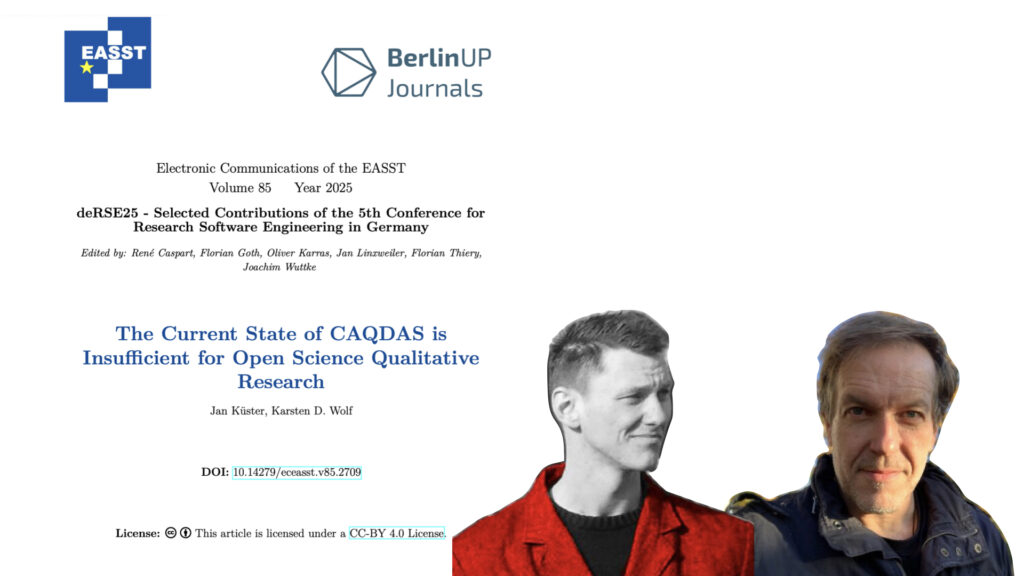
Neuer Artikel zu Open Science mit Qualitative Data Analysis Software
19. Dezember 2025
Jan Küster und Karsten D. Wolf vom Lab „Media & Education“ haben in der aktuellen Ausgabe der Zeitschrift Electronic Communications of the EASST Vol. 85 (2025): deRSE25 – Selected Contributions of the 5th Conference for Research Software Engineering in Germany, einen Beitrag „The Current State of CAQDAS is Insufficient for Open Science Qualitative Research“ (Open Access: doi: eceasst.v85.2709 – LINK zum Artikel) veröffentlicht. Dabei analysieren die beiden Autoren, welche Probleme bei der Umsetzung von Open Science Prinzipien mit den aktuell vorhandenen qualitativen Forschungssoftware-Produkten auftreten. Sie leiten daraus Anforderungen für die Weiterentwicklung von Open Source Software zur Unterstützung von Open Science im qualitativen Forschungsparadigma ab.
Abstract: Qualitative research, which relies on diverse methods and complex data, is increasingly utilising Qualitative Data Analysis Software (QDAS), also known as Computer-Aided Qualitative Data Analysis (CAQDAS). While enhancing data management, coding and transparency, the current CAQDAS landscape is dominated by proprietary software and presents significant challenges for open science principles. High costs, vendor lock-in and closed data formats hinder collaboration, data reuse and reproducibility. This study conducted a systematic review of 28 CAQDAS tools, which were identified through comprehensive searches. The review examined the tools‘ licensing, costs, platform availability, format support, interoperability, collaboration, AI integration, adherence to the FAIR principles for research software, auditability, security, and sustainability from the perspective of stakeholders. The findings reveal that, although proprietary tools offer broad format support and some collaboration features, they are expensive and often lack sufficient on-premises options for sensitive data, locking users into specific workflows. Open-source alternatives exist but often suffer from limited sustainable funding, smaller communities and less comprehensive features or documentation, which makes them less accessible, particularly for non-technical users. Furthermore, many tools lack the robust real-time collaboration and detailed audit trails that are necessary for transparency and intersubjective validation. AI integration is emerging, but it often operates as a black box, limiting user control and raising privacy concerns due to reliance on commercial vendors. Furthermore, support for FAIR principles, security policies and plug-in architectures remains marginal across the field. In conclusion, the current state of CAQDAS is inadequate for fully supporting open science qualitative research practices, such as collaborative, transparent and reproducible analysis, and long-term data archiving. There is a critical need to develop accessible, extensible and collaborative open-source CAQDAS tools via community-driven approaches, in order to advance both research methods and teaching.