


ComAI-Lectures
All ComAI-Lectures are held in English and are recored. The recordings of the ComAI-Lectures can be found on our YouTube-Channel.

Felicia Loecherbach (University of Amsterdam): Inside the Feed: Data Donation and Political Behaviour on Social Media
- Datum: 23. June 2026
- Location: Bremen Press-Club
9. April 2026
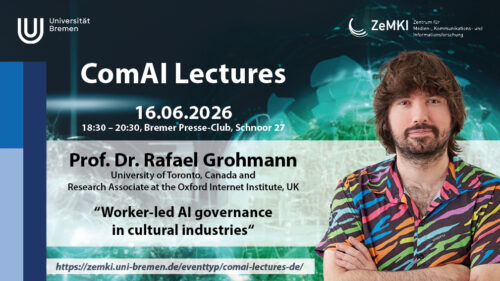
Rafael Grohmann (University of Toronto, Canada): Worker-led AI governance in cultural industries
- Datum: 16. June 2026
- Location: Bremer Presse-Club
Abstract This presentation examines worker-led AI governance, understood as the collective ability of workers, through unions, cooperatives, grassroots collectives, and social movements, to shape how AI is used, managed, deployed, negotiated, or refused at work. Grounded in ongoing empirical research with cultural workers across the Americas, the talk analyzes one specific dimension of worker-led AI (…)
8. April 2026
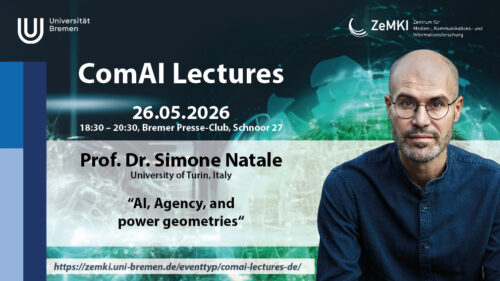
Prof. Dr. Simone Natale (University of Turin): AI, Agency, and Power Geometries
- Datum: 26. May 2026
- Location: Bremer Presse-Club
Abstract One of the paradoxes of AI is that it is a global phenomenon, but at the same time, it is always situated in specific, local contexts and cultures. While approaches that aim to study local cultures of AI are important, there is the risk of neglecting their insertion within the broader geographies and politics (…)
8. April 2026

Gabriela Molina León (Aarhus university, Denmark): The Impact of GenAI on Visualization Research and Practice
- Datum: 5. May 2026
- Location: Bremer Presse-Club
Abstract Generative AI has become a significant trend in visualization research and practice since the release of ChatGPT in 2022. Despite this, we do not know enough about how visualization professionals are actually using Generative AI, its benefits, and disadvantages. In this talk, I will present a series of projects that illustrate the current advances (…)
8. April 2026
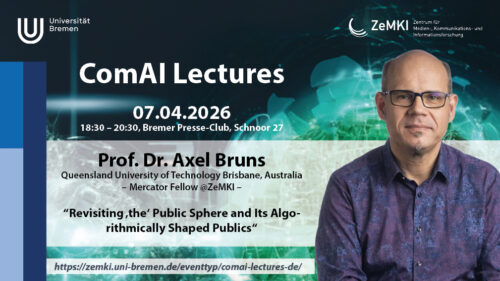
Prof. Dr. Axel Bruns (Queensland University of Technology, Brisbane, Australia): Revisiting 'the' Public Sphere and Its Algorithmically Shaped Publics
- Datum: 7. April 2026
- Location: Bremer Presse-Club
Bio Axel Bruns is an Australian Laureate Fellow and Professor in the Digital Media Research Centre at Queensland University of Technology in Brisbane, Australia, and a Chief Investigator in the ARC Centre of Excellence for Automated Decision-Making and Society. His books include Are Filter Bubbles Real? (2019) and Gatewatching and News Curation: Journalism, Social Media, (…)
17. March 2026
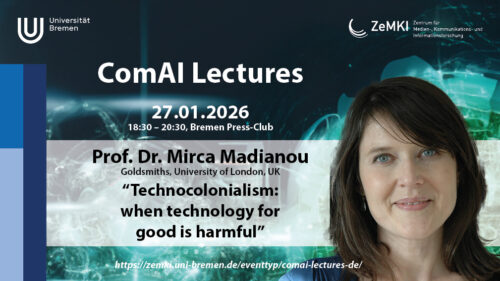
Prof. Dr. Mirca Madianou (Goldsmiths, university of London): Technocolonialism: when technology for good is harmful
- Datum: 27. January 2026
- Location: Bremer Presse-Club
Abstract With over 300 million people in need of humanitarian assistance and with emergencies and climate disasters becoming more common, AI and data are being championed as forces for good and as solutions to the complex challenges of the aid sector. In this talk based on my new book, Technocolonialism: when technology for good is (…)
16. January 2026
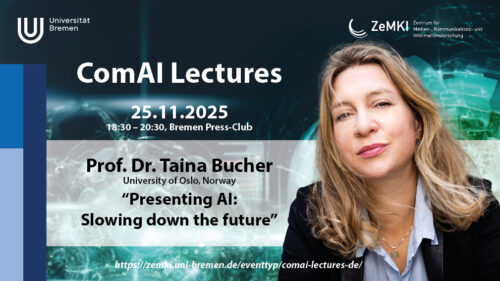
Taina Bucher (University of Oslo): Tech Transitions - Presenting AI: Slowing down the future
- Datum: 25. November 2025
- Location: Bremer Presse-Club
Abstract AI promises speed, efficiency, and seamless automation, yet in pursuing these ideals, we risk marginalizing practices and temporalities that matter: slowness, reflection, imperfection, and the capacity to linger. This talk reframes the conversation about AI futures by focusing not only on what is to come, but on what we risk losing in the process. (…)
10. November 2025
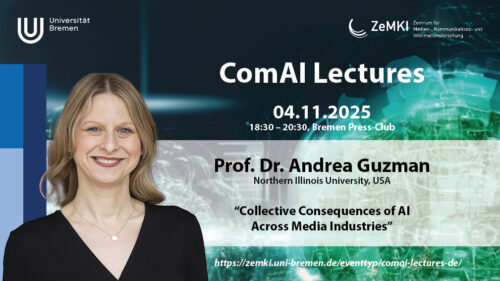
Prof. Dr. Andrea L. Guzman (Northern Illinois University): The Collective Consequences of AI Across Media Industries
- Datum: 4. November 2025
- Location: Bremer Presse-Club
Abstract This talk examines the shared implications of emerging AI technologies across media industries. Advancements in generative artificial intelligence are bringing rapid changes to communication industries. AI applications can perform increasingly human-like roles in the communication process and, as such, can augment and even automate human media work in profoundly different ways from predecessor technologies. (…)
3. November 2025